CIRIS Publishes Essay Collection on Religious Freedom in Comparative Perspective
The Cambridge Institute on Religion and International Studies (CIRIS) has published a special collection of four essays examining freedom of religion or belief (FoRB) in comparative perspective. Each of the essays examines controversies, conditions, and strategies of FoRB around the world. The series is the product of a collaboration between the CIRIS and The Review of Faith & International Affairs. All the essays in this collection are adapted from research articles previously published in a theme issue of The Review on “Freedom of Religion and Belief Across the Commonwealth,” a project generously supported by the Commonwealth Initiative for Freedom of Religion or Belief (CIFORB).
The contents of the essay collection include:
The International Diversification of Players Promoting Freedom of
Religion or Belief
By Monica Duffy Toft, M. Christian Green, and Dennis R. Hoover
Religion and Illiberal Democracy in India Today
By Amrita Basu
Freedom of Religion or Belief and the Pursuit of Religious Harmony
in Southeast Asia
By M. Christian Green and Monica Duffy Toft
Understanding
the Right to FoRB: Lessons from Indonesia and India
By Christoph GrГјll and Erin K. Wilson
В
В
New Report on Religious Reform in Saudi Arabia
In its capacity as the Secretariat for the Transatlantic Policy Network on Religion & Diplomacy (TPNRD) CIRIS has released a new report on Saudi Arabia and the Limits of Religious Reform by Sciences Po associate professor Stéphane Lacroix. Commissioned at the request of TPNRD participants, Lacroix’s paper argues that Prince Mohammed bin Salman’s push for religious moderation and social reform—which has won praise from many Western observers—has less to do with ideology and more to do with his consolidation of power.
Lacroix presented an earlier draft of this paper at the TPNRD conference at the United Nations in New York November 2018. The paper will be published in an upcoming issues of the The Review of Faith & International Affairs.
CIRIS and Doing History in Public Discuss вЂhistory, policy, and religion’
Tom Smith and Helen Sunderland from the blog Doing History in Public recently discussed issues of history, policy, and religion with CIRIS Managing Director Judd Birdsall. Tom Smith is both a CIRIS Graduate Research Associate and an editor of Doing History in Public.
Doing History in Public: Hi Judd. Could you tell us a bit more about CIRIS and its work?
Judd Birdsall (CIRIS): The Cambridge Institute on Religion & International Studies (CIRIS) is a multi-disciplinary research centre at Clare College, Cambridge. We aim to provide students, practitioners, and the general public with credible and engaging insights that will shape new scholarship, sound policy, and constructive debate on the role of faith in international affairs.
To those ends, we host seminars and lectures in Cambridge, we support the work of several Cambridge PhD students working on relevant topics, and we serve as the secretariat for the Transatlantic Policy Network on Religion and Diplomacy (TPNRD). The TPNRD fosters collaboration on religion-related issues among officials and diplomats from the UN, EU, US, Canada, and about a dozen European countries.
DHP: And what led you to want to bridge the gap between religion, academia, and policymaking?
Birdsall: Academics and policymakers speak very different languages and operate with different professional challenges and incentives. It can be hard to bridge those gaps, especially on a topic as complex and sensitive as religion. And yet policymakers need greater religious literacy if they are going to create and implement effective policies and programmes on religion-related issues and scholars of religion (and religious leaders) need great policy literacy if they are going to have a positive impact on how governments analyse and engage religious communities.
When I was serving in the US State Department’s Policy Planning Staff I brought together some colleagues to start a group we called the Forum on Religion and Global Affairs. The Forum mainly focused on bringing scholars of religion and international affairs to give lectures at the Department. When I came to Cambridge for my PhD in 2011 I had the idea creating something like that forum, but in reverse: an academic centre that engages diplomats.
Because policymakers and academics speak different professional languages, CIRIS encourages what we might call вЂtranslational scholarship’. We hold events and produce publications that package the insights of academics in a format that is useful for policymakers and other kinds of practitioners. As part of our work for the TPNRD we commission policy-literate academics to write reports on key topics at the intersection of religion and diplomacy. For instance, for our most recent TPNRD conference we commissioned a report on religion and the Sustainable Development Goals and a report on international perceptions of Western religious freedom advocacy.
DHP: What’s the role of historians within CIRIS?
Birdsall: A major role. Our president, Professor Andrew Preston, is a leading historian of religion and diplomacy. His monumental, prize-winning book Sword of the Spirit, Shield of Faith traces the history of religion in American foreign relations from the Puritans to Barack Obama. Several of our graduate research associates are historians. Many of the events we host have a historical focus.
DHP: How well do you think the goals of public history and of policymaking align, and where do you wish there were more dialogue between the two?
Interview: Christopher Douglas on вЂReligion and Fake News’
In January 2018 CIRIS released a fascinating new report by Prof Chris Douglas on religion and fake news. The report explores the religious dimension of fake news in both Europe and the United States and offers recommendations for how policymakers and other leaders can fight back against faith-based fake news.
Christopher Douglas teaches American literature and religion at the University of Victoria in British Columbia. He wrote the report for the Transatlantic Policy Network on Religion and Diplomacy, which CIRIS serves as secretariat.
(Click here for a version of the report with hyperlinks rather than endnotes.)
In this interview, members of the CIRIS team engage Prof Douglas on several of the issues raised in his report.
В
CIRIS: In your report you identify three asymmetries when it comes to religion and fake news in the US and Europe. What are those asymmetries and why do they matter?
Douglas: First, in the 2016-17 elections, fake news circulated more among Americans than Europeans. Second, fake news circulates among conservatives more than liberals. Third, fake news targeting conservatives often features religious themes.
In my paper I try to figure out why those asymmetries exist. I hypothesize that part of the explanation is the history in the U.S. of a particular faith tradition – white Christian fundamentalism – that cultivated skepticism to mainstream sources of knowledge like universities and professional journalism. This faith tradition didn’t just oppose modern knowledge – it cultivated institutions of counter-expertise to oppose ideas like evolution, Bible criticism, and now climate change.
CIRIS: You argue that the “alternative information ecosystem” of conservative American Protestant evangelicalism has made that community particularly vulnerable to fake news. And yet all religious communities create, at least to some extent, their own distinctive institutions that reinforce their belief systems. Why have American evangelicals proven more vulnerable than, say, American Catholics?
Douglas: Conservative American Protestant evangelicals – or, more narrowly, fundamentalists – contested two academic ideas that have generally been accepted by Catholics and mainline Protestants. The fundamentalist tradition was born in opposition to the science of evolution and to the historical-critical method of Biblical criticism, especially as they accelerated in the late nineteenth and early twentieth centuries. These bodies of modern expertise are officially and generally (to the extent they are understood) accepted by American Catholics and mainline Protestant churches.
What makes American fundamentalism distinct is its construction of a significant network of counter-expertise supporting its theological views on creationism and the inerrant, literal Word of God. Christian fundamentalist Bible colleges and universities, publishers and bookstores, newspapers and magazines, radio and then television shows, museums, websites, and campus ministries, together formed an infrastructure of institutions that resisted elite, secular expert knowledge. This extensive network has no sizable analogue in other Western countries.
CIRIS: For decades religious conservatives have rebuked secular liberals for replacing objective truth with subjectivism and relativism. Now it seems the script has flipped. How did we end up in this odd historical situation where those proclaiming a commitment to truth are falling for fake news and relativists are preaching the importance of objective truth?
CIRIS Research Associate Tobias MГјller Contributes Chapter to Report on Muslims in Europe
13 July 2025 - CIRIS Graduate Research Associate Tobias MГјller recently contributed a chapter in a report on Muslims in the UK and Europe published by the Centre for Islamic Studies at Cambridge University. MГјller’s chapter, вЂConstructing Islam and Secularism in the German Islam Conference,’ argues that beyond the intentions expressed by government officials, the aims of the Conference and the expectations towards Muslims prescribe major restructuring measures of the Muslim community, cooperation with security agencies, and alignment with an undetermined set of “German values.” The full report, co-edited by Paul Anderson and Julian Hargreaves, presents papers from a symposium the Centre for Islamic Studies held in May 2016.
CIRIS Research Associate Edits Special Journal Issue on Religion and Violence
2 May 2026 - CIRIS Graduate Research Associate Matthew Rowley recently edited a collection of essays for the journal Transformation. The special issue, coedited with Dr Emma Wild-Wood, focuses on religion, hermeneutics and violence. Central to each essay is the relationship between readers, texts, and killing. Key questions addressed in the volume include:
- What causes religious violence?
- What is the relationship between beliefs, texts and violence done in the name of God?
- How should one respond to historical violence within their own tradition?
- How should one respond to acts of violence performed by those in another faith community?
- How are harmful beliefs formed and what can be done to prevent believers from doing the unbelievable?
Rowley contributed two articles to the collection. The
co-authored introductory article summarises вЂthe state of modern scholarship
on key debates concerning religion and violence, [and] encourages the careful
study of how individuals or groups in peculiar historical circumstances interact
with their sacred texts and beliefs in a way that facilitates violence or
oppression’.
Rowley’s second article examines how people come to вЂinhabit’ a particular sacred text and frame their violence through that text. As case studies, the article looks at individual violence (child sacrifice), communal violence (conquest), and eschatologically oriented violence (cosmic war). It вЂexamines one common practice among many who believe their killing pleases or is willed by God—inhabiting biblical texts. Focusing on the Abrahamic and Mosaic narratives and on eschatology, [it explains] part of the process whereby individuals and groups come to believe that they are participating in killing patterned on or prophesied in scripture. Finally, this article [suggests] a scripture-based approach aimed at moving an individual or group away from the harmful habitation of sacred texts’.
Contents:
- вЂReligion, Hermeneutics and Violence: An Introduction’ (Matthew Patrick Rowley and Emma Wild-Wood).
- вЂThe Use of Violent Biblical Texts by the Lord’s Resistance Army in Northern Uganda’ (Helen Nambalirwa Nkabala).
- вЂEarly Modern Religious Violence and the Dark Side of Church History’ (John Coffey).
- вЂChristian Responses to Islamism and Violence in the Name of Islam’ (Colin Chapman).
- вЂChild Sacrifice, Conquest and Cosmic War: On the Harmful Habitation of Biblical Texts’ (Matthew Patrick Rowley).
- вЂChristian Hermeneutics and Narratives of War in the Carolingian Empire’ (Robert A.H. Evans).
Sage has made articles 1, 3 and 4 open access.
CIRIS Commissions Report on the Marrakesh Declaration
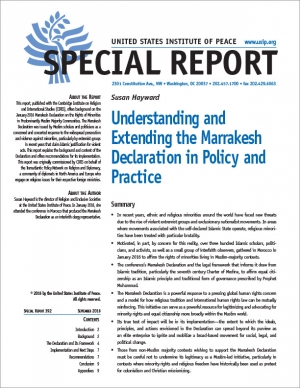 3 Oct. 2016 - CIRIS has co-published a new report with the
US Institute of Peace (USIP) on the Marrakesh Declaration on the Rights of
Minorities in Predominantly Muslim Majority Communities. The report explores
how policymakers and practitioners can further the aims of this seminal
declaration.
3 Oct. 2016 - CIRIS has co-published a new report with the
US Institute of Peace (USIP) on the Marrakesh Declaration on the Rights of
Minorities in Predominantly Muslim Majority Communities. The report explores
how policymakers and practitioners can further the aims of this seminal
declaration.
Susan Hayward, director of Religion and Inclusive Societies at USIP, authored the report and presented it to the Transatlantic Policy Network on Religion and Diplomacy at the network’s consultation in Washington in June 2016. Hayward attended the January 2016 conference in Marrakesh that produced the Declaration and has closely monitored its impact and implementation.
Summary from the front page of the report:
- In recent years, ethnic and religious minorities around the world have faced new threats due to the rise of violent extremist groups and exclusionary nationalist movements. In areas where movements associated with the self-declared Islamic State operate, religious minorities have been treated with particular brutality.
- Motivated, in part, by concern for this reality, over three hundred Islamic scholars, politicians, and activists, as well as a small group of interfaith observers, gathered in Morocco in January 2016 to affirm the rights of minorities living in Muslim-majority contexts.
- The conference’s Marrakesh Declaration and the legal framework that informs it draw from Islamic tradition, particularly the seventh century Charter of Medina, to affirm equal citizenship as an Islamic principle and traditional form of governance prescribed by Prophet Muhammad.
- The Marrakesh Declaration is a powerful response to a pressing global human rights concern and a model for how religious tradition and international human rights law can be mutually reinforcing. This initiative can serve as a powerful resource for legitimizing and advocating for minority rights and equal citizenship more broadly within the Muslim world.
- Its true test of impact will be in its implementation—the extent to which the ideals, principles, and actions envisioned in the Declaration can spread beyond its purview as an elite enterprise to ignite and mobilize a broad-based movement for social, legal, and political change.
- Those from non-Muslim majority contexts wishing to support the Marrakesh Declaration must be careful not to undermine its legitimacy as a Muslim-led initiative, particularly in contexts where minority rights and religious freedom have historically been used as pretext for colonialism and Christian missionizing.
Birdsall co-authors new report on transatlantic cooperation on religious freedom
CIRIS managing director Judd Birdsall has co-authored a new policy report on FoRB - Recognising our Differences can be Our Strength: Enhancing Transatlantic Cooperation on Promoting Freedom of Religion or Belief. The briefing is the outcome of two 2015 transatlantic policy dialogues on вЂFreedom of Religion or Belief and Foreign Policy’, one at Wilton Park in the United Kingdom in February 2015 and the other at Georgetown University in the United States in October 2015. The project was funded by a вЂBridging Voices’ grant from the British Council awarded to the University of Sussex and the University of Notre Dame, in partnership with the European University Institute and the University of Milan. The final report was co-authored by Judd Birdsall, Fabio Petito, Dan Philpott, and Silvio Ferrari.
The Policy Brief suggests a shift in policy emphasis and put forward 7 key recommendations to enhance transatlantic cooperation on the promotion of FoRB worldwide:
1.Draw upon transatlantic church-state differences as an asset
2 вЂIRF’ vs вЂFoRB’ – Be mindful of the subtle differences in language
3 Seek collaboration between вЂreligious freedom’ and вЂreligious
engagement’
4 Upgrading the listening mode – enhance knowledge of and training on FoRB
5 Build coalitions and new multilateral strategies to engage FoRB violators
6 Bolster the nascent multinational and transnational FoRB networks
7 Share stories of struggling with religious diversity
В
For media or other enquiries on the Policy Brief, please contact
In Europe:
Dr Fabio Petito
Department of International Relations
School of Global Studies
University of Sussex, UK
E:
In North America:
Professor Daniel Philpott
Center for Civil and Human Rights
University of Notre Dame, USA
E:
CIRIS’s Tobias MГјller’s MPhil Thesis on вЂContemporary Islamic Thinkers’ Understandings of Secularism’ Now Available
CIRIS research associate Tobias Müller’s Cambridge University MPhil thesis on Contemporary Islamic Thinkers’ Understandings of Secularism is now available online. Müller’s abstract summarises the thesis this way:
“The public and academic debate on the relation between Islam and secularism has been forcefully revived since 9/11 and the “Arab Spring”. Especially essentialist and monolithic depictions by Western scholars have claimed the incompatibility of Islam with secularism as a prerequisite for democracy. Another strand of literature claims that evidence of Islam’s democratic essence (Esposito and Voll 1994) offers a wide variety of indigenous Islamic concepts and institutions such as Shura (consultation), ijmaʿ (consensus) and ijtihad (independent reasoning) that provide a tradition with strong reasons for Muslims to adopt “modern” democratic principles and even to a secular state organization. However, these accounts of the “secular potential” in Islam often ignore the conceptual differences and contexts when Islamic thinkers talk about secularism. Moreover, secularism is often only dealt with as a universal by-product or precondition for democracy rather than a distinct multidimensional discursive element. This essay contributes to filling this gap by analysing the understandings of secularism of two eminent contemporary Muslim thinkers, Rachid Ghannouchi and Abdolkarim Soroush. Informed by Dallmayr’s framework of “Comparative Political Theory”, this essay demonstrates that both Ghannouchi and Soroush argue in favour of democracy in Muslim societies with a certain degree of secularism in the sense of a primacy of popular collective decisions over religious rules. Both their visions meet the criteria of Stepan’s “twin tolerations” and thereby prove the possibility of an Islamic doctrinal argument in favour of secularism. However, it is only possible to apprehend their understandings of secularism by relating it to their conceptualizations of modernity and democracy in the postcolonial situation.”
CIRIS’s Judd Birdsall Publishes Recommendations on Religion and Diplomacy for Next US President
CIRIS managing director Judd Birdsall has published an article entitled вЂKeep the Faith: How American Diplomacy Got Religion, and How to Keep It†in the summer 2016 issue of The Review of Faith & International Affairs.
In his article, Birdsall argues that “any discussion of post-Obama U.S. international religious freedom (IRF) policy needs to acknowledge two basic structural realities. First, the State Department’s IRF Office is arguably the strongest and healthiest it has ever been. Second, the State Department as a whole is more institutionally attentive to religion than at any time in living memory. The next administration will have the duty and opportunity to consider afresh where IRF fits—conceptually, practically, and bureaucratically—within the State Department’s greatly expanded architecture for religion and diplomacy.”
The full summer 2016 issue of the journal, with its collection of essays on “Faith, Freedom, and Foreign Policy: Recommendations for the Next President,” is available here.
В